
Puppy Incubator vs Heat Lamp: Which Is Right?
Table of Contents
- Puppy Incubator vs Heat Lamp: Quick Comparison
- How Temperature Regulation Works in Newborn Puppies
- Heat Lamps: Pros, Cons, and Safety Risks
- Professional Incubators: Features and Advantages
- Recognizing Signs of Hypothermia in Newborn Puppies
- Cost-Benefit Analysis: Incubators vs Heat Lamps
- Breed-Specific Thermal Requirements
- DIY Setups vs Professional Equipment
- Frequently Asked Questions
Last Updated: August 26, 2026
Puppy Incubator vs Heat Lamp: Quick Comparison
Before we start, the photo shows a white heat lamp in the whelping box. If you use a white light, they are generally used with livestock. Those heat lamps can cause vision issues in dogs and puppies. You may want to research this. Better is a ceramic infrared bulb (which is heavier and needs to be more securely mounted, or at least a red heat lamp that is treated to reduce eye issues in canines.
When newborn puppies arrive, maintaining the right body temperature is critical for survival. A puppy incubator vs heat lamp represents the core decision breeders, rescue organizations, and veterinary clinics face when caring for at-risk or neonatal litters. Both provide warmth, but they operate on fundamentally different principles.
Heat lamps create a hot spot, useful for supplemental warmth but unpredictable for a newborn puppy's fragile body. Professional incubators create a thermal gradient, maintain consistent ambient temperature, and let you monitor conditions in real time. One is a tool you hope works. The other is engineered equipment designed specifically for neonatal care.
Feature |
Heat Lamp |
Professional Incubator |
|---|---|---|
Temperature precision |
±5-10°F variance |
±1°F control (75-95°F range) |
Thermal gradient creation |
Inconsistent |
Engineered for optimal distribution |
Fire hazard risk |
High (open heating element) |
Minimal (enclosed, thermostat-controlled) |
Burn risk to puppies |
Significant if too close |
Controlled by design |
Real-time monitoring |
Manual only |
Digital display with thermocouple |
Setup time |
10-15 minutes |
20-30 minutes (one-time setup) |
Initial cost |
$30-80 |
$825-1,225 |
Durability |
1-2 seasons |
5-10+ years with proper care |
Ease of cleaning/disinfection |
Moderate |
Easy (glass enclosure) |
Best for |
Supplemental warmth in whelping room |
Primary care for at-risk or orphaned puppies |
How Temperature Regulation Works in Newborn Puppies
Why Precise Thermal Control Matters
Newborn puppies cannot regulate their own body temperature for the first two to three weeks of life (peer-reviewed research). They cannot shiver, have no fat reserves to burn for warmth, and their thermoregulation system hasn't developed yet.
When a puppy's core body temperature drops below 95°F, hypothermia begins (vet.cornell.edu). At 90°F, metabolism slows dramatically. At 85°F and below, organ systems start shutting down. The puppy becomes lethargic, stops nursing, and begins dying within hours. Overheating (above 99°F sustained) triggers dehydration, respiratory distress, and organ damage equally effectively.
This is why "close enough" doesn't work with neonatal puppies. A heat lamp maintaining 85°F in one corner and 105°F in another creates a survival lottery. Professional incubators eliminate that lottery by maintaining consistent, monitored temperature across the entire enclosure.
Thermal Gradient and Body Heat Distribution
Puppies need a thermal gradient, warmer on one side, cooler on the other, so they can move toward warmth when cold and away when warm, a natural behavior they can't do internally yet.
A heat lamp creates a gradient by accident. The area directly under the lamp gets scorching; six inches away, it's cool. Professional incubators engineer this gradient intentionally. The ceramic infrared heater warms puppies about one inch into their body, not just the skin surface. The glass enclosure distributes warmth evenly, creating a space where temperature stays stable whether a puppy is in the center or at the edge.
Puppies in a proper thermal gradient nurse better, digest food more efficiently, and gain weight faster.
Heat Lamps: Pros, Cons, and Safety Risks
Heat lamps are inexpensive and require minimal setup, screw in a bulb, clamp the fixture, plug it in. For supplemental warmth in a whelping room where the dam is present, they work adequately. But this breaks down fast with orphaned puppies, premature litters, or breeds prone to neonatal complications.
Fire Hazard and Burn Risk
A heat lamp is an open heating element suspended over a confined space filled with flammable materials: bedding, blankets, and paper. The bulb itself reaches 300-400°F (the FDA). If the lamp shifts or bedding gets too close, you have a fire waiting to happen. Breeders have lost entire litters this way.
Burn risk to puppies is equally serious. If a lamp hangs too low, puppies can burn their skin or eyes from radiant heat. These burns often go unnoticed until infection sets in days later.
Professional incubators eliminate both risks. The heating element is enclosed and thermostat-controlled, so it cannot exceed the set point. There's no open flame or exposed hot surface a puppy can contact.
Temperature Inconsistency and Hot Spots
Heat lamps create hot spots, areas of intense heat surrounded by cooler zones. A puppy directly under the lamp might be at 105°F while one three inches away is at 75°F. This forces a dangerous choice: keep the lamp high enough to be safe but ineffective, or low enough to work but risking burns and fire.
Heat lamps also have no feedback mechanism. You cannot see actual temperature inside the box unless you place a thermometer there and check it manually every few hours. If the lamp ages and dims slightly, you might not notice the temperature dropping until puppies show hypothermia signs.
Professional incubators use a fast-acting type J thermocouple that monitors conditions continuously. A digital display shows exact temperature in real time. If temperature drifts, you see it immediately and can adjust the PID controller.
Professional Incubators: Features and Advantages
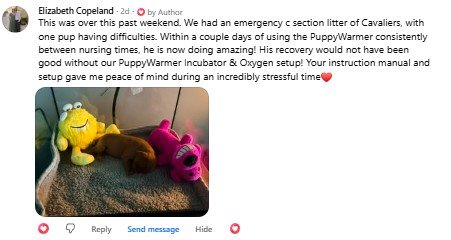
A professional puppy incubator is engineered specifically for neonatal care. Every component, the heater, thermostat, enclosure, air circulation, is designed to keep vulnerable newborn puppies alive.
Precise Temperature Control and Monitoring
The heart of a professional incubator is its PID (Proportional Integral Derivative) learning controller. This pulses electricity to the ceramic infrared heater in precise increments, maintaining temperature within one degree of your set point (75-95°F range, adjustable in one-degree increments).
This precision keeps puppies in the optimal zone for growth and metabolism. At 95-99°F, a newborn puppy's body can focus energy on nursing, digesting, and gaining weight instead of burning calories to stay warm. Temperature stays consistent whether the room is 65°F or 75°F; the incubator compensates automatically. (it can maintain temperature at lower room temperatures, but there is no reason to have a room colder if newborn puppies are in the room)
Real-time monitoring through the digital display means you catch problems immediately. The thermocouple sensor is fast-acting, detecting temperature changes within seconds. If ambient room temperature drops suddenly, the incubator detects it and increases heat output before puppies are affected.
Safety Standards and Durability
Professional incubators are built to veterinary and breeding standards. The glass enclosure is designed for easy cleaning and disinfection between litters, critical for preventing disease transmission. The closed-cell mat underneath provides comfort and grip while being washable and durable.
The Solid State Relay (SSR) in professional incubators lasts ten times longer than traditional switches, meaning fewer mechanical failures over years of use. A well-maintained professional incubator lasts 5-10+ years. A heat lamp typically needs replacing after one or two seasons. preparing your home.
Safety features are built in. The double-locked temperature controller prevents accidental reprogramming. Proper venting creates air exchange and helps drive out CO2, preventing suffocation risk.
Recognizing Signs of Hypothermia in Newborn Puppies
Hypothermia develops silently in newborns. By the time you notice obvious signs, the puppy is already in critical condition.
Early signs include lethargy (unusually sleepy or unresponsive), weak nursing (tries to nurse but doesn't suckle effectively), and slow heart rate (should be 120-160 beats per minute in a healthy newborn; below 100 indicates cold stress).
Body temperature taken rectally with a digital thermometer is the definitive indicator. Below 95°F is hypothermia; below 90°F is severe. At this point, the puppy needs immediate warming and veterinary care.
Prevention is infinitely easier than treatment. A properly maintained incubator or heat lamp setup that you monitor consistently prevents hypothermia from developing. The moment you see early signs, increase the ambient temperature slightly and monitor closely.
Cost-Benefit Analysis: Incubators vs Heat Lamps
Initial Investment and Long-Term Value
The upfront cost difference is stark. A decent heat lamp setup costs $30-80. A professional incubator costs $825-1,225. That's a 10-15x difference in initial investment.
But consider the full picture: A heat lamp requires replacement bulbs (every 6-12 months), occasional fixture repairs, and replacement every 1-2 years. Over five years, you might spend $400-600 on heat lamp replacement and supplies.
A professional incubator has minimal consumables (the fleece mat can be replaced for under $50). The Solid State Relay doesn't wear out like older switches. Over five years, your total cost of ownership is the initial purchase price plus maybe $100 in maintenance.
The real cost difference isn't in dollars, it's in puppy survival and breeder peace of mind. A heat lamp setup that fails or causes a fire costs lives. A professional incubator that maintains precise temperature and lets you monitor continuously prevents emergencies before they happen.
Energy Efficiency and Operating Costs
Heat lamps consume 60-150 watts; professional incubators consume 110-220 watts. The difference in electricity cost is negligible, $5-15 per month.
What matters more is that professional incubators use energy efficiently. The PID controller pulses the heater rather than running continuously, reaching and maintaining temperature faster with less total energy. A heat lamp either runs full power (wasteful) or you turn it on and off manually (inconsistent).
For professional breeders and rescue organizations, a professional incubator is the only practical choice. For someone managing a single litter with an attentive dam present, a heat lamp is adequate supplemental warmth. Once you're managing orphaned puppies, premature litters, or high-risk breeds, the incubator becomes essential.
Breed-Specific Thermal Requirements
Different breeds have different neonatal needs. Large breed puppies are born larger and stronger. Small and toy breed puppies are born tiny and fragile, losing body heat faster and needing more precise temperature control.
Brachycephalic breeds (English Bulldogs, French Bulldogs) have respiratory challenges from birth and benefit from incubators with oxygen concentrator compatibility. Premature or small-for-gestational-age puppies need the most precise control because they lack fat reserves to maintain body heat.
Heat lamps don't account for these differences. Professional incubators let you adjust temperature in one-degree increments based on breed and individual puppy needs.
The Breeders Series 12x12x12" incubator ($825) is designed for small and toy breeds or individual puppies needing intensive care. The 18x18x18" model ($1,025) handles medium to large breed litters. The 24x18x18" model ($1,225) accommodates large breed litters like English Bulldogs or Great Danes.
Choosing the right size matters. An incubator that's too small forces you to move puppies in and out, disrupting the thermal environment. One that's too large wastes space and energy.
DIY Setups vs Professional Equipment
Why Professional-Grade Equipment Matters for Neonatal Care
The DIY approach, heat lamps, makeshift boxes, manual temperature monitoring, works until it doesn't. Many breeders have used DIY setups successfully for years. But "it's worked so far" isn't the same as "it's safe."
The risk isn't in the average case. It's in the edge cases: the night the furnace fails and room temperature drops to 55°F, the moment a heat lamp fixture shifts and touches bedding, the hour you're asleep and don't notice a puppy showing early hypothermia signs.
Professional equipment is engineered to handle those edge cases. The thermostat compensates automatically for room temperature swings. The enclosed design eliminates fire risk. The continuous digital monitoring means you catch problems in real time, even if you're asleep.
For rescue organizations and veterinary clinics, professional equipment is non-negotiable. These facilities manage multiple litters simultaneously, often with staff turnover and inconsistent monitoring. For breeding operations managing high-risk breeds or large litters, professional equipment pays for itself in reduced puppy mortality and increased confidence.
The choice between DIY and professional isn't about cost. It's about whether you can afford to lose puppies to preventable thermal stress.
When you're managing newborn puppies, the equipment you choose determines their survival odds. Heat lamps are affordable and familiar, but they create hot spots, fire hazards, and inconsistent conditions. Professional incubators deliver the precise temperature control, real-time monitoring, and durability that neonatal puppies need to survive and thrive.
For rescue organizations and breeders managing at-risk litters, a professional incubator like the Puppywarmer Breeders Series isn't an upgrade, it's the foundation of neonatal care. The Breeders Series 18x18x18" incubator ($1,025) handles medium to large breed litters with PID learning controller precision, fast-acting thermocouple monitoring, and a glass enclosure designed for easy disinfection. For small and toy breeds, the 12x12x12" model ($825) provides the same advanced features in a compact footprint. Both create the thermal gradient and consistent warmth that give vulnerable puppies their best chance. Add to cart and see why breeders and rescue groups trust Puppywarmer to keep their most critical litters alive.
Save one puppy with the system, and you are well on your way to making your Puppywarmer system one of the best investments you have made for your breeding program.

Frequently Asked Questions
What is the ideal temperature for a newborn puppy incubator?
Newborn puppies require an ambient temperature between 85°F and 90°F during their first week, with the whelping box maintained at 95°F to 99°F. Professional incubators like the Puppywarmer Breeders Series maintain precise control between 75°F and 95°F in one-degree increments, allowing you to adjust for individual puppy needs and breed requirements. This level of precision prevents hypothermia while avoiding overheating.
Are heat lamps a fire hazard for newborn puppies?
Yes. Heat lamps pose significant fire risks, including burns to puppies from direct contact, ignition of bedding materials, and overheating of the whelping space. Hot spots develop easily beneath heat lamps, creating dangerous temperature variations. Professional incubators eliminate these hazards through enclosed glass designs, thermostat-controlled heating, and ceramic infrared heaters that warm puppies 1 inch into their body without surface burn risk.
How do I recognize signs of hypothermia in newborn puppies?
Hypothermic puppies display weakness, lethargy, reduced suckling reflex, slow heart rate, and pale gums. Severely hypothermic puppies may appear lifeless. Early signs include shivering and restlessness. Maintaining consistent ambient temperature through proper incubation prevents hypothermia entirely. If you notice these symptoms, warm the puppy gradually to 98°F-99°F body temperature and consult your veterinarian immediately.
How long do puppies need to stay in an incubator?
Duration depends on breed size, health status, and litter dynamics. Most healthy puppies transition to a heated whelping box in days but some puppies whether it be due to breed or condition stay in the incubator two weeks or more. The goal of the incubator is to help the puppies be strong enough to join their littermates in the whelping box. At-risk, premature, or orphaned puppies may require 4-8 weeks. Small breeds like toy breeds typically need shorter incubation periods than large breeds. Professional incubators accommodate extended stays with easy cleaning, proper ventilation, and space to accommodate growth.
What makes a professional incubator better than a DIY heat lamp setup?
Professional incubators provide precise, thermostat-controlled temperature regulation, eliminating dangerous hot spots and cold zones. They feature solid-state relays for durability, fast-acting thermocouples for accurate sensing, and closed-cell mats that are easy to disinfect between litters. DIY setups risk inconsistent temperatures, fire hazards, and bacterial contamination. Professional equipment meets neonatal care standards and reduces puppy mortality.
This article was written using GrandRanker