Whelping Equipment for Rescue Groups: 2026 Guide
Table of Contents
- Essential Whelping Equipment for Rescue Groups
- Emergency Whelping Supplies Checklist
- Puppy Incubator for Rescue: Choosing the Right Size
- Neonatal Puppy Care Protocols for Rescue Operations
- Sanitation Protocols for Multi-Dog Whelping Environments
- Budget-Friendly Whelping Equipment Sourcing for Nonprofits
- Equipment for Special Needs and High-Risk Litters
- Conclusion
Last Updated: August 19, 2026
Neonatal puppy mortality remains one of the most preventable losses in rescue work. At Puppywarmer, we've worked with rescue groups across the country to close that gap, the difference between a thoughtful whelping kit and an improvised one shows up in puppy survival rate within the first 72 hours of life. This guide covers every piece of whelping equipment rescue groups need, from the birthing setup through emergency intervention tools, incubator selection, sanitation protocols, and budget-friendly sourcing for nonprofits.
Essential Whelping Equipment for Rescue Groups
Whelping equipment for rescue groups is the collection of supplies, containment structures, thermal management tools, and monitoring instruments used to support a mother dog and her litter from delivery through the first critical weeks of life. Unlike a private breeder's setup, a rescue environment must accommodate unknown health histories, multiple concurrent litters, and frequent turnover, which means durability and ease of disinfection matter as much as functionality.
Whelping Box Requirements and Pig Rails
The whelping box should be sized so the mother can fully stretch out while leaving a manageable perimeter for puppy containment. Allow at least 12 inches beyond the dam's length on each side.
Pig rails are horizontal rails run around the interior walls 3-4 inches from the floor and 3-4 inches out from the wall, preventing the mother from accidentally crushing a puppy against the side. Rescue groups handling large-breed dams or first-time mothers should treat pig rails as mandatory. Box materials matter for sanitation: sealed plywood, high-density polyethylene, and wipe-clean plastic panels all outperform raw wood in multi-dog environments. Avoid carpet-lined boxes for rescue use, since they harbor bacteria between litters. Heating a pigrail or the floor area directly beneath increases the likelihood that the puppies will be protected by the pig rail.
Bedding, Pads, and Puppy Containment
Bedding serves two functions: thermal insulation for newborns and absorbency for the dam. Stock at least three to four washable pads per box and rotate them through the washer and dryer continuously.
Puppywarmer's washable whelping box pads are available in three sizes: the 38"x38" Whelping Box Pad at $35, the 50"x50" Whelping Box Pad at $40, and the 62"x62" Whelping Box Pad at $45. Each pad is soft and absorbent on top with a waterproof backing, preventing moisture from saturating the box floor and creating a hypothermia risk for newborns. For puppy containment in the early days, low foam bumpers or rolled towels placed inside the box perimeter help keep neonates away from the dam's legs without restricting her movement.
Emergency Whelping Supplies Checklist
Every rescue needs a fully stocked emergency kit assembled before whelping begins, not assembled in a panic at 2 a.m. when a puppy is in distress.
Intervention Tools Every Rescue Needs on Hand
The following checklist covers the core intervention tools:
- Digital thermometer (rectal, for checking newborn body temperature)
- Aspiration bulb or Delee mucus trap for clearing airways
- Surgical gloves, multiple pairs
- Sterile scissors and forceps for umbilical cord care
- Unwaxed dental floss or umbilical cord clamps
- Iodine or chlorhexidine solution for umbilical cord care
- Lubricant for assisting stuck pups during delivery
- Clean, dry towels for stimulating and drying neonates
- Puppy identification collars or colored yarn ties (one color per puppy)
- Gram scale for weighing puppies at birth and every 12 hours after
- Record keeping charts or a dedicated notebook
A digital thermometer is one of the most underused tools in rescue whelping. Newborn puppies cannot regulate their own body temperature and rely entirely on external warmth; a thermometer tells you whether a cold, lethargic puppy is hypothermic or has another underlying issue. The thermoneutral zone for neonatal puppies in the first week of life is approximately 85-90°F environmental temperature, dropping gradually over the first four weeks.
Feeding Supplies for Orphaned and Weak Puppies
Orphaned and weak puppies require supplemental feeding within hours of birth. Tube feeding is the fastest method for a non-nursing neonate, but syringe feeding with a proper nipple is safer for rescuers without tube-feeding experience.
Puppywarmer's Extra Small Threaded Syringe Feeding Nipples (5-Pack) at $40 are designed specifically for newborn toy breeds and kittens. For small-to-medium breed puppies, the Small Threaded Syringe Nipple Feeders (5-Pack) at $40 feature a soft silicone nipple that helps puppies latch with a fuller mouth. Stock puppy milk replacer formulated for dogs, not cow's milk or human infant formula. According to guidance from the American Veterinary Medical Association on neonatal care, cow's milk creates osmotic diarrhea in neonatal puppies and accelerates dehydration.
Puppy Incubator for Rescue: Choosing the Right Size
A puppy incubator is the single most impactful piece of whelping equipment a rescue group can invest in for at-risk and orphaned neonates. The right incubator maintains a stable thermoneutral zone, provides proper air exchange, and is easy to clean and disinfect between litters.

A glass-enclosure thank you Texas Star Rescue for this wonderful photo of a super-comfy puppy resting on a fleece insert under warm ceramic infrared heat, in a precisely controlled Puppywarmer incubator.
Incubator Model |
Interior Dimensions |
Best For |
Price |
|---|---|---|---|
Breeders Series 12x12x12" |
12"x12"x12" |
Toy breeds, single at-risk puppies |
$825 |
Breeders Series 18x18x18" |
18"x18"x18" |
Small-to-large breeds, most rescue litters |
$1,025 |
Breeders Series 24x18x18" |
24"x18"x18" |
Large breeds, extended stays, big litters |
$1,225 |
The 12x12x12" model is ideal for a single critical puppy or a toy-breed neonate that needs round-the-clock monitoring in a home foster setting. The 18x18x18" model is the most popular choice for rescue operations, handling medium-to-large breed litters. The 24x18x18" model is built for large breeds with extended incubator stays: English Bulldogs, French Bulldogs, Rottweilers, Great Danes, and Bernese Mountain Dogs.


Temperature Regulation and the Thermoneutral Zone
The thermoneutral zone is the environmental temperature range in which a neonate can maintain normal body temperature without expending metabolic energy. For puppies in week one of life, this is approximately 85-90°F, dropping to around 80°F by week three.
All three Puppywarmer Breeders Series incubators use a PID learning controller that pulses electricity to a ceramic infrared heater, maintaining temperature between 75-95°F in one-degree increments. The ceramic infrared heater warms puppies one inch into their body rather than just warming the air surface. A fast-acting type J thermocouple provides accurate temperature sensing, and a Solid State Relay replaces the mechanical switch of earlier units, lasting ten times as long. The glass enclosure creates a thermal gradient rather than uniform heat, which is physiologically important: puppies can self-regulate position to find their comfort zone.
Oxygen Support for At-Risk Newborns
Aspirated puppies and premature neonates frequently benefit from supplemental oxygen alongside thermal support. The Puppywarmer Standard Oxygen Concentrator at $725 delivers 90% oxygen concentration at one liter per minute, with a maximum flow rate of three liters per minute, precisely within the puppy-friendly range that avoids oxygen toxicity. For puppies with aspirated or bacterial pneumonia, the Puppywarmer Rechargeable Handheld Mesh Nebulizer at $75 allows nebulization treatment while the oxygen concentrator continues running at optimal flow rates. According to neonatal oxygen therapy guidelines from the American College of Veterinary Internal Medicine, supplemental oxygen in the first hours of life can significantly improve outcomes for neonates with respiratory compromise.
Neonatal Puppy Care Protocols for Rescue Operations
Neonatal puppy care protocols are the standardized procedures a rescue organization follows to monitor, feed, and document each puppy's progress from birth through weaning. Consistent protocols are what separate a rescue that loses puppies to preventable causes from one that doesn't. hospital-grade equipment.
Monitoring Puppy Weight and Growth Tracking
Weight is the most reliable early indicator of puppy health. A neonate that loses more than a small fraction of birth weight without recovering by day two, requires immediate intervention.
The standard monitoring schedule for rescue litters: weigh each puppy at birth and record on a litter chart; weigh every 12 hours for the first week before feeding; continue daily from week two onward until puppies are weaning consistently. Use a gram scale accurate to one gram. Healthy puppies generally double their birth weight by day ten. A puppy that plateaus or drops weight two measurements in a row needs supplemental feeding and veterinary assessment.
Record Keeping and Puppy Identification
Record keeping is the part of neonatal care that rescue groups most consistently underinvest in, and it's the part that most directly affects their ability to identify a problem puppy before it's too late.
A basic litter record should capture: each puppy's identification color or number, birth weight and time of birth, weight at every check, feeding amounts and frequency for supplemented puppies, any observed abnormalities, and temperature readings for any puppy placed in the incubator. Digital spreadsheets work well for groups managing multiple litters simultaneously. Paper charts kept at the whelping box work for single-litter fosters.
Sanitation Protocols for Multi-Dog Whelping Environments
Proper sanitation is essential shelter or multi-foster operation. Pathogens move fast when multiple litters share the same space, equipment, or handlers.
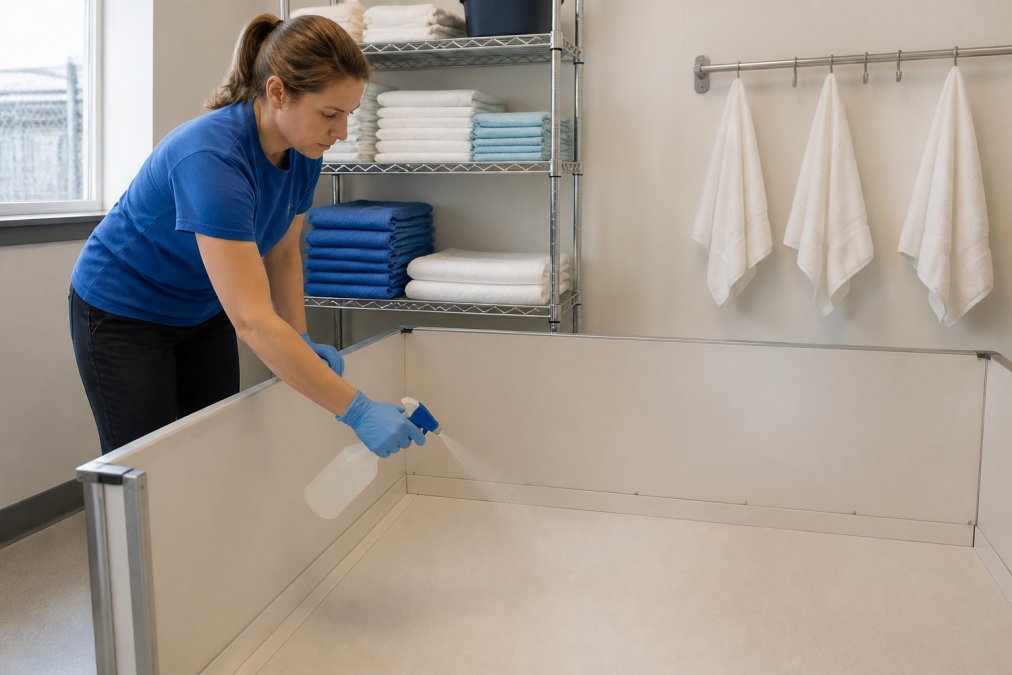
A rescue volunteer wearing nitrile gloves spraying disinfectant onto a whelping box interior in a bright, clean shelter room, with folded whelping pads stacked on a nearby shelf and clean towels hanging on a rack
Post-whelping sanitation protocol for each litter:
- Remove all bedding immediately after whelping. Wash whelping pads in hot water with a pet-safe detergent and dry completely before reuse.
- Wipe down all hard surfaces of the whelping box with a veterinary-grade disinfectant. Puppywarmer recommends Rescue Brand Disinfectant. Allow full contact time per the product label before rinsing. A thorough rinse is always recommended after disinfecting.
- Disinfect the incubator glass enclosure with an appropriate cleaner. The glass construction of Puppywarmer incubators is specifically designed for this purpose, unlike fabric or foam-lined units where residue harbors bacteria.
- Discard single-use items: surgical gloves, cord clamps, and any absorbent materials that contacted fluids.
- Wash hands and change outer clothing layers between handling litters from different dams.
For high-volume rescue environments, according to shelter medicine sanitation guidelines from the UC Davis Koret Shelter Medicine Program, establishing a color-coded system for equipment assigned to individual litters dramatically reduces cross-contamination risk.
Budget-Friendly Whelping Equipment Sourcing for Nonprofits
Rescue groups operating as registered 501(c)(3) nonprofits have sourcing options that private breeders don't. Many suppliers offer nonprofit pricing tiers or donation programs that are never advertised publicly; a brief email explaining your mission and volume is often enough to open a conversation.
Practical sourcing strategies for nonprofit rescue operations include: applying for grants from the Petco Foundation, PetSmart Charities, and the ASPCA; partnering with veterinary schools for surplus equipment or discounted supplies; joining bulk purchasing cooperatives through national rescue networks; and prioritizing durability over initial cost. A glass-enclosure incubator with a Solid State Relay that lasts ten times as long as a mechanical switch is a better long-term investment than a cheaper unit requiring replacement after two seasons. Treat whelping supplies as capital equipment, not a variable cost, and calculate the cost per litter over a realistic equipment lifespan.
Equipment for Special Needs and High-Risk Litters
High-risk litters require a modified equipment approach beyond the standard whelping kit. The most common high-risk scenarios in rescue are: premature litters, singleton puppies, litters with cleft palates, and neonates born to malnourished or sick dams.
Premature litters need extended incubator time at the higher end of the temperature range. The PID controller on Puppywarmer incubators allows precise one-degree adjustments, which matters when a premature puppy's thermoregulation is even less developed than a full-term neonate. Cleft palate puppies cannot nurse or take a standard nipple and typically require tube feeding. Singleton puppies lack the natural warmth of littermates and are prone to hypothermia even with a nursing dam present; the 12x12x12" Puppywarmer incubator is purpose-built for this scenario. Aspirated neonates need both thermal support and respiratory intervention simultaneously; the combination of a Puppywarmer incubator with the Standard Oxygen Concentrator and Handheld Mesh Nebulizer addresses all three needs without requiring the handler to move the puppy between devices.
Managing a rescue litter, particularly a high-risk or orphaned one, puts every gap in your whelping setup under pressure at the worst possible time. Puppywarmer's Breeders Series incubators provide precise temperature control between 75-95°F via a PID learning controller and ceramic infrared heater, a glass enclosure that creates the thermal gradient neonates need and cleans easily between litters, and a Solid State Relay built for the long-term demands of a working rescue operation. Pair any incubator with the Standard Oxygen Concentrator for complete neonatal respiratory support. Get started with Puppywarmer and give your next litter the conditions they need to survive and thrive.
Frequently Asked Questions
What equipment do I need for whelping as a rescue group?
A functional whelping setup requires a whelping box with pig rails, washable waterproof pads, a digital thermometer, heating pad or incubator, aspiration bulb, surgical gloves, umbilical cord care supplies, puppy identification collars, a gram scale for weight monitoring, and feeding tubes or syringe feeders for weak puppies. Rescue groups handling orphaned or premature litters should also have a dedicated puppy incubator and oxygen concentrator available for emergency intervention.
What are the benefits of using an incubator for rescued puppies?
A puppy incubator for rescue provides precise temperature control within the thermoneutral zone, typically 85-95°F for the first week of life, which newborns cannot maintain on their own. Unlike heat lamps or heating pads, a quality incubator maintains consistent warmth throughout the enclosure, removes CO2 through proper venting, and allows oxygen supplementation. This combination directly supports puppy survival rate in at-risk litters, particularly for orphaned, premature, or aspirated neonates.
Can I use a kiddie pool as a whelping box?
A kiddie pool can work as a temporary whelping box for larger breeds since it provides a rounded, contained space that is easy to clean. The main drawback is that standard kiddie pools lack pig rails, the protective ledges that prevent the dam from crushing puppies against the wall. If you use one, attach a DIY pig rail around the interior perimeter. For rescue groups managing multiple litters, a purpose-built whelping box with built-in rails and a low entry point is more practical and safer long-term.
How do rescue groups maintain sanitation in whelping areas?
Post-whelping sanitation starts with removing soiled bedding immediately and rotating washable whelping pads through the laundry. Wipe down all hard surfaces, including the whelping box walls and incubator interior, with a veterinarian-approved disinfectant between every litter. Glass-enclosure incubators are easier to sanitize than plastic units. Rescue groups running multiple concurrent litters should assign dedicated equipment per whelping station where possible to reduce cross-contamination risk.
What is the 3-3-3 rule for rescue animals?
The 3-3-3 rule describes the adjustment timeline for rescued dogs: roughly 3 days to decompress from the stress of intake, 3 weeks to learn the routine of a new environment, and 3 months to feel fully settled and comfortable. For neonatal rescue litters, this framework is less applicable since newborn puppies have immediate physiological needs around warmth, feeding, and stimulation that must be met from the first hours of life, well before any behavioral adjustment period begins.