

Canine Neonatal Oxygen Therapy Guidelines
Table of Contents
- When Puppies Need Oxygen: Recognizing Puppy Respiratory Distress Symptoms
- Neonatal Puppy Resuscitation Protocol: Step-by-Step
- Oxygen Delivery Methods for Neonatal Puppies
- Choosing the Best Oxygen Concentrator for Dogs
- Managing Oxygen Concentration and Preventing Toxicity
- Hypothermia Prevention and Neonate Stabilization
- Monitoring Respiratory Function and Heart Rate
- Weaning Puppies Off Oxygen Support
- Frequently Asked Questions
Last Updated: August 29, 2026
When Puppies Need Oxygen: Recognizing Puppy Respiratory Distress Symptoms
A newborn puppy struggling to breathe demands immediate recognition of distress signs. The first 24 to 48 hours after birth are critical, especially for puppies born via cesarean section, premature puppies, or those from large litters.
Watch for these specific respiratory distress indicators:
- Gasping or open-mouth breathing at rest, not just during nursing
- Cyanosis (bluish or pale mucous membranes around the mouth and gums)
- Rapid, shallow breathing that continues beyond the first few minutes after birth
- Nasal flaring with each breath, indicating increased respiratory effort
- Retractions (visible indentation of the chest wall between ribs during breathing)
- Wheezing or crackling sounds when the puppy breathes
- Lethargy or inability to nurse due to breathing difficulty
- Bradycardia (heart rate below 100 beats per minute in a neonate)
Healthy puppies have pink gums and tongue. Pale or bluish discoloration indicates hypoxemia and urgent need for oxygen therapy. Some puppies show "swimmer syndrome," lying on their side and paddling ineffectively, which often accompanies respiratory distress because the puppy cannot position itself to breathe effectively. Temperature also plays a critical role, a cold puppy will have shallow breathing and poor circulation, worsening respiratory distress.
Neonatal Puppy Resuscitation Protocol: Step-by-Step
When a puppy is born non-responsive or stops breathing, a systematic approach is essential. Panic leads to mistakes.
Initial Assessment and Airway Clearance
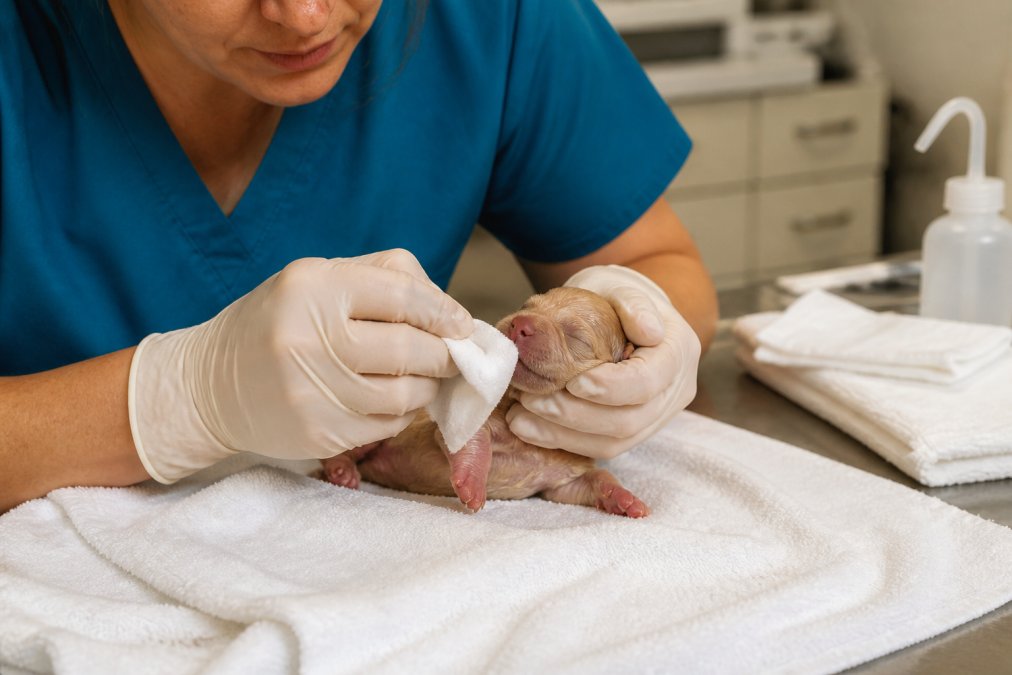
Place the puppy on a clean, dry towel and wipe away visible fluid from the mouth and nostrils using soft cloth or gauze. If the puppy is limp and unresponsive, hold it firmly but gently in both hands and perform a controlled "scooping" motion downward to drain fluid from the airway using gravity. Repeat 3-4 times, pausing between each scoop.
Check for obstruction by looking inside the mouth. If you see thick mucus or meconium, remove it carefully with your finger or a small suction bulb. Never use a human nasal aspirator, the pressure is too strong for a fragile neonate.
Once the airway is clear, assess whether the puppy is breathing by placing your hand near the nose and mouth to feel air movement and listen for breathing sounds.
Stimulation and Respiratory Center Activation
Many puppies born via cesarean section are simply sleepy from anesthesia or delivery stress. Brisk stimulation activates their respiratory center. Rub the puppy firmly with a dry towel, focusing on the chest and back, using firm, deliberate strokes for 15-30 seconds. If the puppy begins breathing on its own, you've succeeded.
Some puppies respond better to temperature stimulus. A slightly cool (not cold) damp cloth on the face can trigger a gasp reflex. If the puppy still isn't breathing after 30 seconds of stimulation, move to positive pressure ventilation.
Positive Pressure Ventilation When Needed
Positive pressure ventilation (PPV) manually delivers oxygen-enriched air into the lungs when the puppy cannot breathe on its own. Use a neonatal resuscitation bag and mask, not a full-size bag. The mask should cover the nose and mouth completely without covering the eyes.
Deliver 20-30 breaths per minute, with each breath lasting about one second (peer-reviewed research). You should see the chest rise slightly with each breath. If the chest isn't rising, the seal isn't tight or the airway is still obstructed. Check again and reposition as needed.
Continue PPV for 15-30 seconds while also giving oxygen. If the puppy shows no response, continue PPV while preparing for advanced oxygen delivery methods.
Oxygen Delivery Methods for Neonatal Puppies
Once a puppy is breathing, the next question is how to deliver oxygen sustainably. Your choice depends on the puppy's condition, available equipment, and duration of needed support.
Flow-By Oxygen and Nasal Cannula Options
Flow-by oxygen directs a stream of oxygen toward the puppy's face without a sealed delivery system, delivering roughly 30-40% oxygen concentration. This method works best for puppies breathing on their own but needing short-term supplemental oxygen. It requires no special equipment beyond an oxygen source and tubing, and allows the puppy to move, nurse, and interact with littermates.
A nasal cannula is a small tube with two prongs that fit gently into the puppy's nostrils, delivering 30-50% oxygen concentration at flow rates of 0.5-2 liters per minute. It's less intrusive than flow-by and allows nursing while receiving oxygen, though some puppies resist the prongs.
Start with low flow rates, a newborn puppy needs only 0.5-1 liter per minute. Too much flow dries out the airway and causes irritation. Monitor the puppy's response; pink mucous membranes and steady breathing indicate adequate oxygen delivery.
Choosing the Best Oxygen Concentrator for Dogs
An oxygen concentrator draws air from the room, filters it, and concentrates the oxygen for delivery. Unlike oxygen tanks that run out, a concentrator is far more practical for breeders and rescue organizations managing multiple litters or frequent emergencies.
The Puppywarmer Standard Oxygen Concentrator delivers 90% oxygen concentration at one liter per minute, with a maximum flow rate of three liters per minute. This concentration and flow range covers the needs of most neonatal puppies.

When selecting a concentrator, look for these specifications:
- Oxygen concentration output: 85-95% is ideal for neonatal work
- Maximum flow rate: At least 3 liters per minute for flexibility
- Noise level: Under 50 decibels is preferable in a breeding environment
- Portability: Can you move it quickly if needed?
- Maintenance requirements: Filter changes should be straightforward
The Puppywarmer concentrator includes genuine replacement filters available in convenient 6-packs. Breeders should change filters every two litters; veterinary clinics should replace them monthly for best performance.
Managing Oxygen Concentration and Preventing Toxicity
More oxygen is not always better. Prolonged exposure to high oxygen concentrations causes oxygen toxicity, damaging lung tissue and creating long-term breathing problems.
For neonatal puppies, keep oxygen concentration between 40-60% during sustained therapy. The fraction of inspired oxygen (FiO2) depends on delivery method and flow rate:
Use the minimum oxygen concentration that keeps mucous membranes pink and the puppy breathing steadily. Start low and increase only if signs of continued hypoxemia appear. Monitor for oxygen toxicity signs: increased respiratory effort, coughing, or fluid accumulation in the lungs (crackling sounds). If these develop, reduce oxygen concentration immediately.
The puppywarmer incubator is vented to help drive out CO2. In the Puppywarmer Incubator, at recommended flow rates, the concentration is highest closest to the cup of the oxygen line. Hypoxic puppies will often line up 2-3“ away from the oxygen line. It is fascinating to see thm locate the oxygen source and align their location to the oxygen concentration level they need. Healthier puppies move further and further away from the oxygen line. As a once hypoxic puppy moves further away from the oxygen line, the action of finding a lower oxygen concentration level is a strong indicator that the treatment method is working.
Watch for rebound hypoxemia when removing oxygen. Some puppies become dependent on supplemental oxygen and struggle when it's removed too quickly. Reduce oxygen gradually, not abruptly.
Hypothermia Prevention and Neonate Stabilization
A cold puppy cannot breathe effectively. Hypothermia reduces metabolic rate, slows the respiratory center, and makes the puppy lethargic. Temperature control is foundational, not optional.
Newborn puppies cannot regulate their own body temperature. Aim for an ambient temperature of 85-90°F for the first week of life, gradually decreasing to 75-80°F by the fourth week (the NIH). For a puppy receiving oxygen therapy, maintain the whelping area at 85-90°F. If the puppy is in an oxygen cage or incubator, the internal temperature should be 95-99°F.
Puppywarmer incubators maintain this exact range with a PID learning controller that adjusts heating automatically. The ceramic infrared heater warms puppies 1 inch into their body, creating the thermal gradient they need for proper development, different from surface heating, which can cause burns while leaving core body temperature too low.
When a puppy is hypothermic, oxygen delivery alone won't save it. The puppy's tissues aren't metabolizing oxygen properly because core temperature is too low. Warm the puppy first, then deliver oxygen.
Monitoring Respiratory Function and Heart Rate
Continuous monitoring tells you whether oxygen therapy is working or whether you need to adjust your approach.
The most important vital sign for a puppy in respiratory distress is heart rate. Normal neonatal heart rate is 120-160 beats per minute (peer-reviewed research). If the heart rate drops below 100 (bradycardia), the puppy is in trouble, usually indicating inadequate oxygenation.
Check heart rate by placing two fingers gently on the inside of the hind leg where the femoral artery runs. Count beats for 15 seconds and multiply by 4, or place your hand on the chest and feel the heartbeat directly.
Respiratory rate (breaths per minute) should be 15-35 in a resting neonate. If the rate is above 40 and sustained, the puppy is working too hard to breathe, suggesting inadequate oxygen concentration or airway obstruction.
Mucous membrane color is your visual monitor. Pink gums and tongue mean adequate oxygenation; pale or bluish color means hypoxemia is present. Check color every 5-10 minutes during active oxygen therapy.
If you have access to a pulse oximeter designed for neonates, target oxygen saturation (SpO2) of 90-95%. Below 90% means inadequate oxygenation; above 95% may indicate excess oxygen delivery.
Monitor for behavioral changes. A puppy receiving adequate oxygen should gradually become more alert, stronger in its suck reflex, and more responsive to stimulation. Persistent lethargy despite oxygen therapy suggests infection, hypoglycemia, or neurological damage from the initial hypoxic event.
Weaning Puppies Off Oxygen Support
The goal of oxygen therapy is to support the puppy until its own respiratory system functions independently.
Start weaning when the puppy meets these criteria:
- Heart rate consistently above 100 beats per minute without oxygen
- Spontaneous breathing at 20-35 breaths per minute
- Pink mucous membranes without supplemental oxygen for 5+ minutes
- Strong suck reflex and ability to nurse
- Increasing alertness and activity
Weaning a puppy off oxygen is easily accomplished in a Puppywarmer incubator. Simply raise the oxygen line up 1-2” every other day. The further distance the oxygen has to travel to reach the puppy necessitates mixing with air and a lower concentration level. Some customers also get a small aquarium air pump and run room air to the other side of the incubator to further lower oxygen concentration while still driving out CO2.
Puppywarmer oxygen concentrators and incubators are built for exactly this scenario. When a puppy needs oxygen at 2 a.m., you need equipment you trust completely. The Puppywarmer Standard Oxygen Concentrator delivers 90% oxygen concentration with intuitive controls and reliable performance. Pair it with precise temperature control from a Puppywarmer incubator, and you've created the environment that gives at-risk puppies their best chance. Start with the concentrator that fits your operation, maintain it properly with replacement filters every two litters, and you'll be ready when the emergency comes.

Frequently Asked Questions
What are the signs that a newborn puppy needs oxygen therapy?
Signs of respiratory distress include gasping, weak crying, pale or blue mucous membranes, slow heart rate below 100 bpm, and apnea episodes. Puppies born to breeds prone to dystocia or those requiring resuscitation at birth often need oxygen support. Observe thoracic excursion—puppies should show visible chest rise with each breath. If a puppy's oxygen saturation drops below 90%, supplemental oxygen is critical for preventing hypoxemia and acid-base imbalance.
How do you perform neonatal puppy resuscitation protocol correctly?
Start with airway clearance: gently wipe the puppy's nose and mouth, remove any mucous membranes obstruction, and ensure airway patency. Apply brisk stimulation by rubbing the puppy's body and stroking its back to activate the respiratory center. If the puppy remains unresponsive after 30 seconds, begin positive pressure ventilation using a small mask at 20-30 breaths per minute. Monitor heart rate continuously—if it stays below 60 bpm, start chest compressions. Maintain body temperature throughout to prevent hypothermia, which slows recovery.
What oxygen concentration is safe for neonatal puppies?
Target 40-60% inspired oxygen for most neonates to avoid oxygen toxicity while preventing hypoxemia. The Puppywarmer Standard Oxygen Concentrator delivers 90% oxygen concentration at one liter per minute, allowing you to blend with room air using a nasal cannula or flow-by method to achieve safe levels. Pulse oximetry should guide titration—aim for oxygen saturation of 90-95%. Never exceed 100% oxygen for extended periods, as this damages lung tissue and increases free radical formation in developing puppies.
How long should a puppy stay on oxygen therapy?
Duration depends on the underlying cause and response. Puppies with transient respiratory distress may need only 2-6 hours of supplemental oxygen, while those with aspiration or sepsis may require 24-72 hours or longer. Weaning begins when the puppy maintains normal oxygen saturation (>95%) breathing room air for 1-2 hours. Reduce flow rate gradually and monitor closely for any return of respiratory effort changes or mucous membrane color deterioration. Breed-specific considerations matter—large breeds with narrower airways may need extended support.
This article was written using GrandRanker